
Local SEO Guide 2026: Complete Strategy to Rank Higher in Local Search
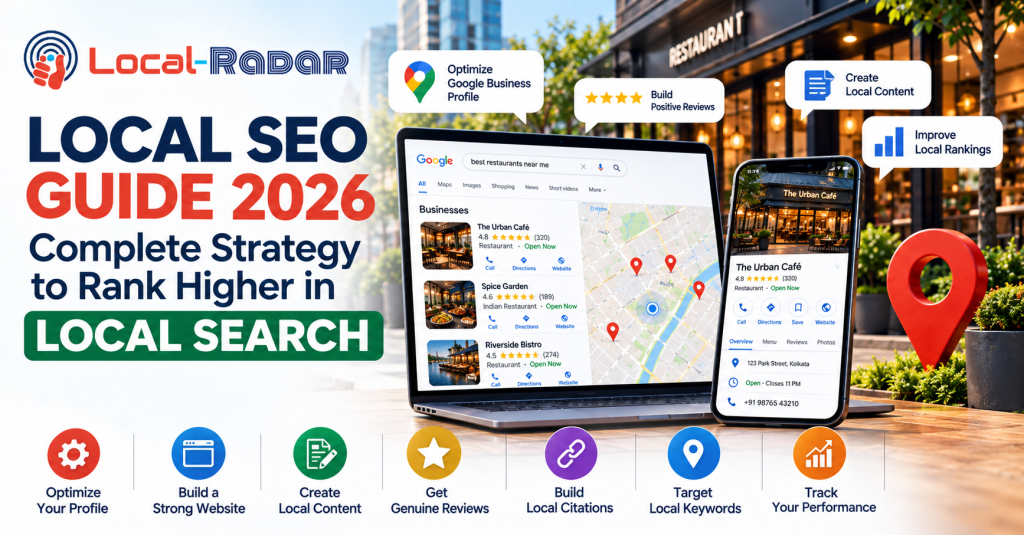
If you run a local business, being visible when customers search for your products or services can make a significant difference to your growth. A customer searching for a restaurant, dentist, salon, real estate agency, repair service, retailer, or professional service is often already close to taking action.
That is why Local SEO remains an important digital marketing strategy in 2026.
Local SEO is the process of improving your online presence so that your business can be discovered by people searching for relevant products or services in a particular geographic area.
However, ranking higher locally is not about adding your city name to every sentence or creating dozens of low-quality pages. Google says local results are primarily influenced by relevance, distance, and prominence, while its broader Search Essentials emphasize helpful, reliable, people-first content and avoiding spam practices.
This guide explains a practical Local SEO strategy businesses can use in 2026.
1. Start With Your Google Business Profile
For many local businesses, the first step should be creating, claiming, and verifying a Google Business Profile.
Google says a verified Business Profile can help businesses appear on Google Search and Maps and lets businesses manage information such as their phone number, website, hours, location, photos, and customer reviews.
Make sure your profile includes:
- Correct business name
- Appropriate primary category
- Accurate address or service area
- Current phone number
- Website
- Opening hours
- Services or products
- High-quality photos
- Relevant business information
Completeness matters because Google says businesses with complete and accurate information are more likely to appear in relevant local searches.
2. Choose the Right Business Category
Your business category helps search engines understand what your company does.
For example, a business should select the category that most accurately represents its primary service rather than choosing several unrelated categories simply because they contain popular keywords.
Your primary category should reflect your actual business.
You can also add relevant secondary categories when appropriate, but avoid trying to manipulate rankings by selecting categories that do not accurately describe your business.
3. Keep Your Business Information Consistent
Consistency is one of the foundations of local SEO.
Your business name, address, phone number, website, and other important details should be accurate across your website, Google Business Profile, social media accounts, and relevant online directories.
Google explains that local business information can come from multiple sources, including the official business website, third-party data, users, and business owners.
This makes it important to regularly check your online presence for outdated information.
If your business moves, changes its phone number, modifies its opening hours, or changes its service area, update your information across important platforms.
4. Build a Strong Local Business Directory Presence
Local business directories can provide additional opportunities for customers to discover your business.
Instead of relying entirely on search engines, businesses can create profiles on relevant local directories where customers search for products and services.
Local Radar is designed to help users discover businesses and places across different categories and locations. A well-maintained Local Radar listing can complement your website and other local marketing channels.
Your directory profile should include:
- Business name
- Category
- Description
- Address or service area
- Phone number
- Website
- Services
- Business hours
- Photos
- Other relevant information
The objective is not to create hundreds of listings simply for links. Focus on relevant, trustworthy directories where potential customers may actually discover your business.
5. Create Location-Focused Website Pages
Your website is an important part of your Local SEO strategy.
If your business serves multiple locations, create genuinely useful pages explaining the services available in each area.
For example, a home-service company might have pages covering different cities or service areas. A multi-location retailer could create individual pages for each physical location.
However, avoid creating dozens of nearly identical pages simply by replacing one city name with another.
Google specifically identifies doorway abuse as a spam practice, including creating multiple similar regional pages that funnel users toward the same destination without providing useful additional value.
Every location page should provide something useful to the customer.
Include local information, services available in that area, location details, FAQs, photographs, directions, and other genuinely relevant content.
6. Optimize Your Website for Local Search Intent
Local SEO is not just about location names.
You need to understand what customers actually search for.
For example:
- “best salon near me”
- “dentist in Kolkata”
- “restaurants near Park Street”
- “AC repair service in Kolkata”
- “real estate agency near me”
Create content around genuine customer questions and needs.
Use relevant search terms naturally in:
- Page titles
- Headings
- Service descriptions
- Meta descriptions
- Image alt text
- Internal links
- Website copy
Google recommends using words that people would use to search for your content and placing them in prominent, descriptive locations.
But don’t overdo it.
Google’s spam policies specifically identify keyword stuffing—unnaturally repeating keywords or locations—as a prohibited practice.
7. Create Helpful Local Content
A strong local SEO strategy should include useful content rather than only promotional pages.
Think about the questions your local customers ask before contacting your business.
A real estate company could publish:
- Neighborhood guides
- Property buying guides
- Local market information
- Frequently asked questions
A restaurant could publish:
- Local food guides
- Seasonal menus
- Dining recommendations
- Event-related content
A healthcare business could publish:
- Educational resources
- Service explanations
- Appointment preparation guides
- Frequently asked questions
Useful content can demonstrate expertise while creating additional opportunities to appear for relevant searches.
Google’s Search Essentials specifically recommends creating helpful, reliable, people-first content.
8. Build and Manage Genuine Reviews
Reviews are an important part of local visibility and customer decision-making.
Google states that prominence in local search can be influenced by information such as links from other websites and the number of reviews a business has. It also says positive ratings can help a business’s local ranking.
Encourage genuine customers to leave honest reviews after using your products or services.
Then respond professionally.
Thank customers for positive feedback and address complaints constructively.
Do not buy fake reviews or manipulate ratings. Authentic customer experiences are more valuable for long-term reputation and trust.
9. Use Local Business Structured Data
Technical SEO also has a role in local search.
Google supports LocalBusiness structured data, which allows businesses to provide structured information about details such as business name, address, hours, departments, and other information.
Depending on your business, you can implement an appropriate LocalBusiness subtype, such as:
- Restaurant
- Store
- Dentist
- HealthClub
- DaySpa
- Other relevant local business types
Google recommends using the most specific applicable LocalBusiness subtype and validating structured data before deployment.
Structured data does not guarantee higher rankings, but it can help search engines better understand the information on your pages.
10. Optimize for Mobile Users
Local search and mobile browsing go hand in hand.
Customers may search for your business while they are travelling, shopping, dining, or looking for an urgent service.
Your website should therefore be easy to use on a smartphone.
Check that:
- Text is easy to read
- Buttons are easy to tap
- Phone numbers are clickable
- Contact forms work properly
- Pages load efficiently
- Location information is easy to find
- Navigation is simple
If a customer discovers your business but struggles to use your website, you may lose the enquiry.
11. Make Your Phone Number Easy to Find
For many local businesses, a phone call is one of the most valuable conversions.
Restaurants, clinics, home-service companies, repair businesses, real estate agencies, legal professionals, and many other businesses can receive direct enquiries through calls.
Make your phone number highly visible on your website and business profiles.
On mobile, use a clickable telephone link so customers can call without manually copying the number.
Also make sure someone is available to answer calls during the advertised business hours.
Local SEO should ultimately support real business outcomes—not simply website traffic.
12. Strengthen Local Authority With Relevant Links
Links from reputable websites can help build your business’s online authority.
Look for legitimate opportunities such as:
- Local news websites
- Industry associations
- Chambers of commerce
- Community organizations
- Local events
- Business partnerships
- Relevant industry publications
Google’s local ranking guidance notes that prominence can be influenced by information such as links from other websites.
However, avoid buying or creating links purely to manipulate rankings. Google’s spam policies identify link spam as a violation.
Focus on earning relevant mentions because your business is genuinely useful or noteworthy.
13. Use Social Media to Strengthen Local Awareness
Social media is not a replacement for Local SEO, but it can support your broader digital presence.
Share:
- Local events
- New products
- Customer stories
- Behind-the-scenes content
- Offers
- Community involvement
- Helpful tips
- Business updates
Use location information naturally when it is relevant.
The goal is to create a recognizable local brand rather than simply publishing promotional posts.
14. Monitor Your Local SEO Performance
SEO requires measurement.
Track metrics such as:
- Local search impressions
- Website traffic
- Phone calls
- Direction requests
- Website enquiries
- Form submissions
- Bookings
- Review growth
- Search queries
- Conversion rates
Google Business Profile provides performance information around interactions such as calls, website clicks, directions, messages, and bookings, depending on the available features for a business.
Use this information to identify what is working and where customers are dropping off.
15. Avoid Common Local SEO Mistakes
Some businesses hurt their own visibility by using shortcuts.
Avoid:
- Keyword stuffing
- Fake reviews
- Incorrect business information
- Duplicate or doorway pages
- Irrelevant directory listings
- Spammy backlinks
- Automatically generated low-value content
- Fake business locations
Google’s spam policies state that practices such as keyword stuffing, link spam, doorway abuse, and scaled content abuse can result in lower rankings or exclusion from Search.
A sustainable Local SEO strategy should prioritize usefulness and accuracy over shortcuts.
Your Local SEO Checklist for 2026
Use this checklist as a starting point:
Google Business Profile
- Claim and verify your profile
- Select the correct category
- Update business information
- Add services and photos
- Maintain accurate hours
Website
- Create useful service pages
- Add location information
- Optimize titles and headings
- Make the website mobile-friendly
- Add clear contact options
Directories
- Create relevant local listings
- Keep information consistent
- Include your website and phone number
- Update outdated profiles
Reviews
- Encourage genuine reviews
- Respond professionally
- Monitor customer feedback
Technical SEO
- Implement relevant LocalBusiness structured data
- Check indexing
- Maintain crawlable pages
- Keep your sitemap updated
Content
- Answer local customer questions
- Publish genuinely useful information
- Avoid repetitive city-based pages
Measurement
- Track calls
- Track enquiries
- Monitor website traffic
- Review local search performance
- Improve based on real customer behavior
Final Thoughts
Local SEO in 2026 is about much more than adding a location to your website.
It is about building a complete, accurate, trustworthy, and useful local presence across Search, Maps, websites, directories, reviews, and other digital channels.
Google’s own guidance makes one point particularly clear: there is no way to pay for a better local ranking. Local results are primarily influenced by relevance, distance, and prominence.
That means businesses should focus on the fundamentals—accurate information, helpful content, genuine reviews, strong websites, relevant local listings, and a good customer experience.
Local Radar can be one part of that strategy, giving businesses an additional platform where potential customers can discover their products and services locally.
The goal is simple:
Get found. Build trust. Make it easy to contact you. Turn local searches into real customers.
Start building your 2026 Local SEO strategy today with a strong local presence across your website, Google Business Profile, relevant directories, and Local Radar.
